
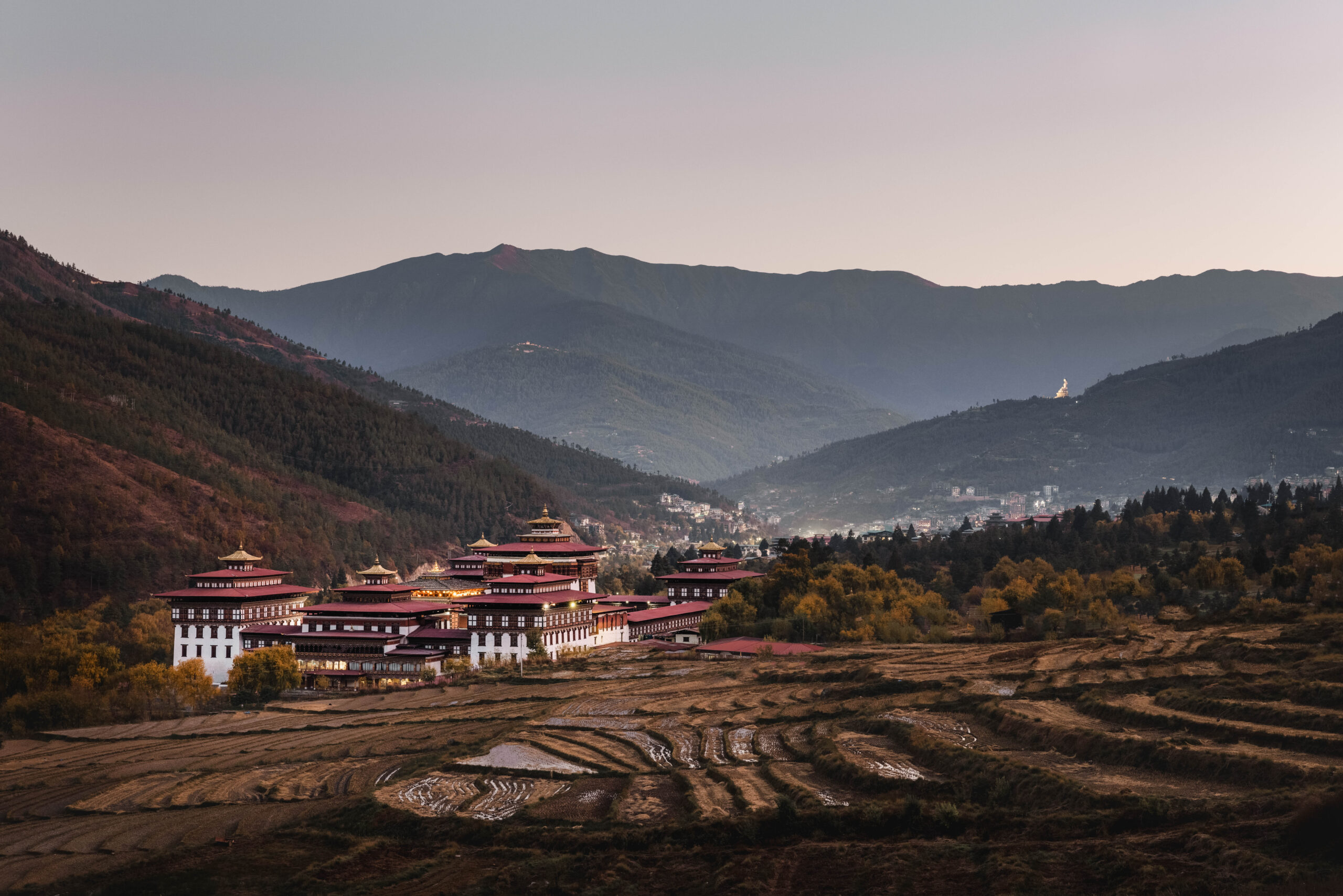
Tashichho Dzong
Visiting these iconic locations offers a unique look into the spiritual and natural heart of the country
Short intro about
Tashichho Dzong
Tashichho Dzong, ‘Fortress of the Glorious Religion’ or ‘Fortress of Auspicious Doctrine’, or popularly known as Thimphu Dzong, is an impressive structure that houses the throne room and offices of the king, the secretariat and the ministries of home affairs and finance. Other government offices are housed in the buildings nearby Tashichho Dzong. It’s been the seat of the Royal Government of Bhutan since 1962 after the capital moved to Thimphu from Punakha.
-In 1216, Lama Gyalwa Lhanangpa built the Dho-Ngon (blue stone) Dzong on a hill above Thimphu where Dechenphodrang now stands.
-When Zhabdrung Ngawang Namgyel came to Bhutan in the 17th century, the followers of Lama Gyalwa Lhanangpa were completely crushed and the Dho-Ngon Dzong fell into the hands of Zhabdrung.
-In 1641 Zhabdrung rebuilt the Dho- Ngon Dzong and named it Tashicho Dzong (Fortress of the auspicious religion Fortress).
-In 1694 it was enlarged by the 4th Desi Tenzin Rabgye During the reign of the 5th Desi, Gedun Chophel.
-In 1698, the Dzong caught fire and was restored. The 10th Desi, Mipham Wangpo built the Kagyu Lhakhang inside the Tashicho Dzong. In 1747 the Dzong was enlarged at the initiative of the 13th Desi, Chogyal Sherab Wangchuck.
-During the reign of the 16th Desi, Sonam Lhendup and the 13th Je Khenpo Yonten Thaye the Dzong caught fire for a second time.
-The two then proposed to move it from Dechenphodrang and build a new Dzong at the site of its current location. In 1777, during the time of the 18th Desi, Jigme Singye, the Kunrey (assembly hall of the monks) in the Dzong was renovated, as it was totally dark inside. It was further renovated by the 25th Desi, Pema Cheda in 1807.
-Phurgyal during his tenure as the 32nd Desi, added the Di Tsang Lhakhang in 1826 and installed many new statues.
-In 1869 the Dzong once again caught fire, during the time of the 47th Desi. The Dzong was extensively repaired. The 52nd Desi, Kitshelpa Dorji Namgyal built the Lamai Lhakhang and the Mithrugpa Lhakhang.
-He also installed a statue of Mithrugpa (Akshobya), facing west.
-The Guru Lhakhang was built by the Thimphu Dzongpon Kuezang Thinley in 1886, under the direction of Karmapa Khachab Dorji The Lhakhang houses images of Guru Nangsi Zilnon (complete triumph over all illusory appearances, or the great subjugator), the Guru Tshengye (eight manifestations of Guru Padmasambhava) and the Gongdue Lhatshog (images of Abhipraya Samaja).
-In 1955,the 3rd king Jigme Dorji Wangchuck moved the capital from Punakha to Thimphu.
-His late Majesty Jigme Dorji Wangchuck took the initiative of renovating the Dzong in 1962.
-The entire Dzong was rebuilt in traditional fashion, without nails or written plans.
-The overall renovation works were overseen by Zopen Parpa Yodsel Seven years later, in 1969, corresponding to the Earth Bird Year the Dzong was consecrated by Je Khenpo (chief Abbot) Thripa Yonten Tharchin Je Khenpo Thri Zur Thinley Lhendup and Dorji Lopon Nyizer Tulku.
-In 2002 a newly built Neten Chudrug (16 arhats, those who had extinguished all defilements Thongdrol was consecrated and added to Trashicho Dzong by His Holiness the Je Khenpo.
-The Thongdrol depicting the Buddha Shakyamuni is surrounded by the 16 arhats. The Thongdrol is unveiled to the public annually on the 15th day of the 4th month of the Bhutanese calendar, coinciding with the Duechen Ngazom (Lord Buddha’s Mahaparinirvana) celebration.
-Welcome to Trashi Chho Dzong.
-Knows as “The Fortress of the Glorious religion”.
-It stands on the right bank of the Wangchu (Thimphu) River.
-It is an elevation of 1800 meters approximately above the sea level.
-It geographically stands at 27 degree towards the Northern Hemisphere 89 degree towards Eastern Himalayan.
1.We are lucky to take pictures from outside Guru Statue.
2.But please refrain from taking pictures, while we are inside the Statue
3.Please refrain from touching wall paintings, statues and other relics inside the Statue.
4.Please maintain low voice, when we are outside/inside Statue.
5.Please always walk clock wise direction.
6.If you want to use washroom, please let me know, I will assist you.
7.Please watch your steps/ Mind your head.
8.Please remove your Footwear, Hats Sunglass while we are entering inside the Statue as a sign of respect.
9.Do remember to keep your mobile silent mode or switched off completely while entering monasteries and other religious places.
10.Do refrain from uttering any negative comments on the royal family, the country’s religion or the chief abbot.
11.Do not wear tight or revealing clothes while visiting religious areas as a sign of respect.
12.Do not throw garbage anywhere except at designated places.
13.Do not feed birds/ animals while visiting natural sites.
-TrashiCho Dzong has three main entrances. The One leads to the south to the administrative section and another to the north leads to the monastic quarter where the dances of the annual festival are performed.
-We can also see the palace of the fifth Druk Gyalpo Jigme Khesar Namgyal Wangchuck and the house of the National Assembly.
-We can see one of the tallest national flag out of 3 (in front of dzong, Lingkana, Headquarter of RBP)
-Eight Lucky Signs
-Two Enterances (1st for VIP and 2nd for General Public)
-Guru Peljor Dorji,Green Tara ( Ariya Tara).Yellow Tara,4 Lokopalas, Namsey (God of wealth)
-Tshering Dukar, Tandrim (Havagriva), Pema Drukpa kuenley, Phajo Drugom Zhinpo, Khando Sonam Peldon, Drupthop Thangthong Gyalpo, Chana Dorji, Below two marmeid (Nagas)
-Lam Drukpa Kuenley, Yum Sonam Peldon, Yellow Zamala, Yellow Zamala
-Nagas, Wheel of Dharma, Emblem of Buddhism, Four Friends and Formation mount meru.
-Jitsen Milaregpa with Sharop Gyem Dorji
-Rigsum Gonpo (Manjushree, Avalokitesvara and Vajrapani)
-Wheel of Existence
– Gang Tshen
-Mandala for Buddha Shakyamuni
-Cosmic Mandala
-Choe Yum Nam Sum( Buddha, Guru Rinpoche and Zhabdrung)
-Craved form of Tshe Lha Sum (Tshepema, White Tara and Namggyelma)
-The entrance represents the guardian of the four directions. A great stair case leads to the interior of the Dzong.
-There is national emblem on the wall facing the steps and carved pillars that support the ceiling.
-The beautiful proportion courtyard of the central administration and all around are the ministers and Royal chamber.
-The other side of the chamber is the courtyard of the state. In the middle of the courtyard is the new temple built in 1909.
-The ground floor houses a large assembly hall for the monks. The painting inside the former assembly hall is of the highest quality and illustrates different episodes from the life of the Buddha and on the ceiling is a painting of Mandala. The kings’s throne room stands in the middle of the chamber.
-Statue of Green Tara
-Statue of Dorji Namjung
-Statue of Guru Rinpoche/ Padmasambhava
-He is holding the Vajra in the right hand towards the chest and left hand holding tissue with Kapali/ skull. Wearing ritual head seated on lotus throne on top of the moon disc. Benefits , it will help us to get enlightenment.
-Significance of Vajra is to subdue all the negatives .
-Significance of tissue is to capture the 3 poisons.( ignorance, Greed and anger)
-Significance of skull is for the humility
-Significance of Hat is Nyingma traditional
-Significance of lotus is enlightenement
-Significance of moon disc is for purity
-Statue of Dorji Sempa (Vajrasattva)
-Statue of Buddha Ashobhaya (mitrugpa )
-Statue of Zhabdrung Ngawang Namgyal.
-Staue of Guru Drakpo Marchen
-Painings of 16 Arhats with Buddha Skayamuni at Mandala
-4 throne
-Left throne for 4th king Jigme Singye Wangchuck
-Middle one for current King Jigme Khesar Namgyal Wangchuck
-Right one for 70th Je khenpo Trulku Jigme Choeda
-Next for crown Prince Jigme Namgal Wangchuck
Again 5 thrones for 5 Lopens of Zhung Dratsang
1. Dorji Lopen
2.Tshula lopen
3. Yonten lopen
4. Laktshok lopen
5.Tsho lopen
-Statue of thousand Buddha of 8 inch
-1000 painting of Buddha Shakyamuni.
-That has been contributed by 3rd king Jigme Dorji Wangchuck mainly to fulfill 3 pillars of Buddha(that is the body of Buddha).
-Paintings of Tsepata/Cretamukha/ puzzling on the wall
-35 confessions of Buddha and Buddha Shakyamuni with 2 disciples Shariputa and Mongolyana at top
-painting of Kagyu master at top.
-Lhamo Drumchoe
-Thimphu Tshechu
-Coronation of 4th King Jigme Singye Wangchuck in 2nd June,1974.
-Coronation for current King Jigme Jigme Khesar Namgyel Wangchuck in 1st Novermber 2008.
-Royal Wedding for current king in 13th October 2011.
-The constitution draft in 1st November 2008.