
Punakha Dzong
Visiting these iconic locations offers a unique look into the spiritual and natural heart of the country
Short intro about
Punakha Dzong
Punakha Dzong is recognized as the most beautiful Dzong fortress in Bhutan. Walking across the traditional wooden bridge over the Punakha River, visitors can see white buildings standing tall, with red windows on the white exterior walls, dazzling and vivid. May is the most romantic moment in Punakha Dzong. The surrounding jacarandas are in full bloom, and the treetops and green areas are covered with small purple-blue flowers, which look like a dreamlike paradise from afar. Different from other dzongs in Bhutan, Punakha Dzong is mainly decorated and painted. All the window lattices and wooden bars in Punakha Dzong are exquisitely carved and painted with vivid images of auspicious clouds and dragons. Not all clan fortresses possess such luxury and magnanimity as the royal family in this old capital. The house, elaborately carved with dragons and phoenixes is said to have been once the king’s palace.
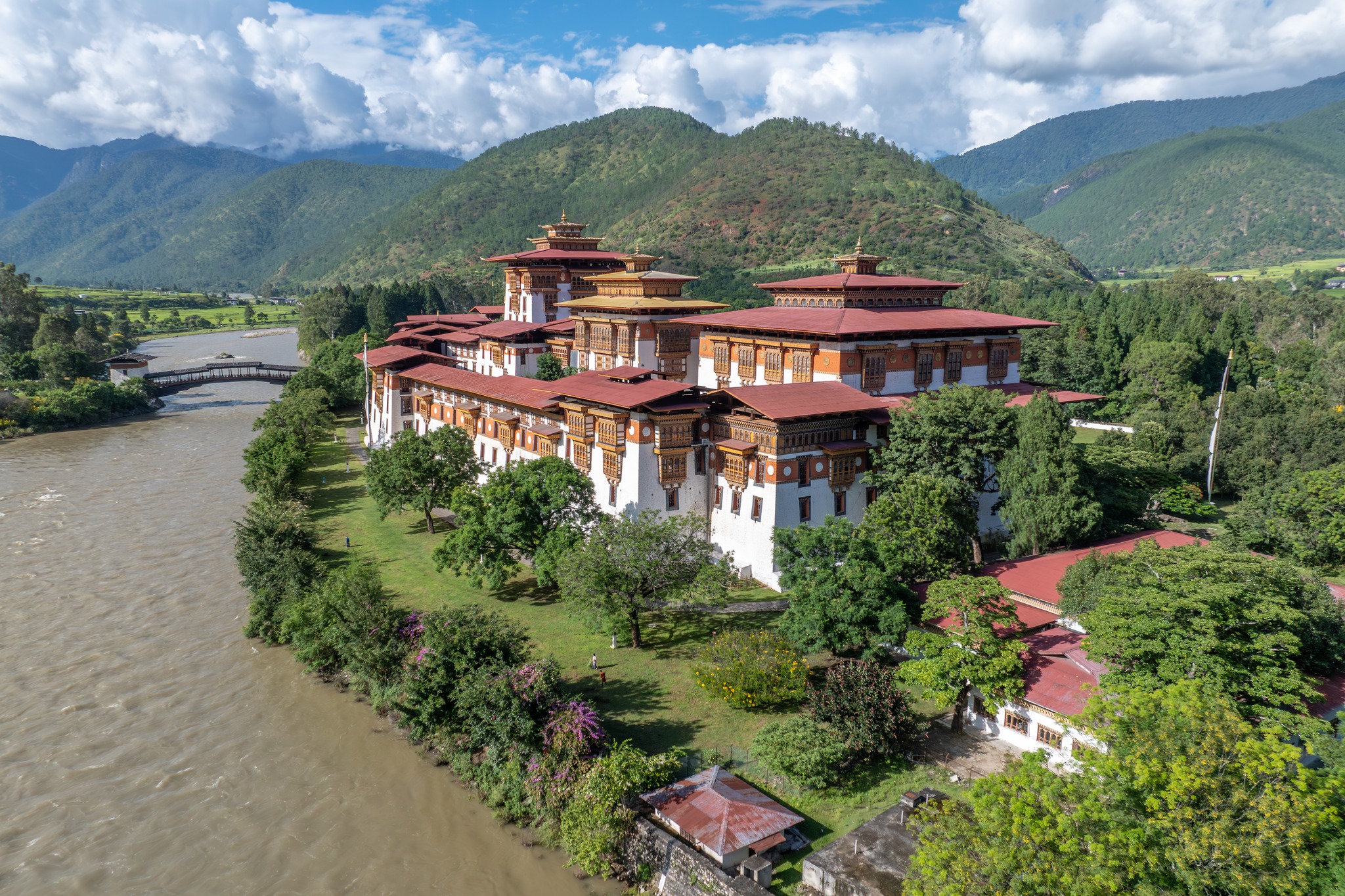
Punakha Dzong is also known as Pungthang Dewai Chenpai Phodrang (Palace of Great Happiness) or (the palace of great happiness or bliss).
THE PHO CHU AND MO CHU:
-The Dzong is located at the confluence of the Pho Chhu (father) and Mo Chhu (mother) rivers in the Punakha–Wangdue valley.
-The source of the Mo chu river is in the northern hills of Ligshi and Laya in Bhutan, and in Tibet.
-The Pho Chu River is fed by glaciers in the Lunana region of the Punakha valley.
After the confluence of these two rivers, the main river is known as Puna Tsang chu or Sankosh River and flows down through Wangdue Phodrang, crosses the Bhutan-India border at Kalikhola and eventually meets the Brahmaputra River.
-Welcome to well come to Punakha Dzong.
-It is an elevation of 1350 meters approximately above the sea level.
-It geographically stands at 27 degree North, 89 degree East
-It is bordered by Gasa, Thimphu and Wangdi Phodrang.
-It is about 72 km away from the capital city and it takes about 2 hours’ drive from the capital city
1.We are lucky to take pictures from outside Monastery.
2.Please refrain from taking pictures, while we are inside the Monastery.
3.Please refrain from touching wall paintings, statues and others relics inside.
4.Please maintain low voice, when we are outside/inside.
5. Please always walk in a clockwise direction when you are visiting and touring religious places.
6. Please remove your Footwear, Hats Sunglass while we are entering inside the Statue as a sign of respect.
7.If you want to use washroom, please let me know. I will assist you.
8. Please watch your steps/ Mind your head.
9. Do remember to keep your mobile silent mode or switched off completely while entering monasteries and other religious places.
10. Do refrain from uttering any negative comments on the royal family, the country’s religion or the chief abbot.
11. Do not wear tight or revealing clothes while visiting religious areas as a sign of respect.
12. Do not throw garbage anywhere except at designated places.
13. Do not feed birds/ animals while visiting natural sites.
-acaranda trees grow around the Dzong, blooming with mauve flowers in the spring.
-There are three stairways to get into the Dzong. In olden days, the stair towards the right was used by Trongsa Penlop and the left by Paro Penlop. The centre stair was used by Daga Penlop when they used to bring their offering to Zhabdrung Ngawang Namgyel.
-Nowadays the centre stair is being used by king and Chief Abbot.
-At the main entrance on top of three staircases are painting on the wall of Namchu Wangdhen, Four Guaedian Kings, Emblem of Buddhism, wind king (Lhu), Tshering Dukar, Four Friends, Asrology chart, Rigsum Gonpo.
-And a diagram with poetry in praise of Zhabdrung Ngawang Namgyel which can be read in any direction.
-In the next entrance is an astrological diagram called Pakha Gey.
1.We are lucky to take pictures from outside Dzong .
2.Please refrain from taking pictures, while we are inside the Temple
3.Please refrain from touching wall paintings, statues and others relics inside.
4.Please maintain low voice, when we are outside/inside.
5. Please always walk in a clockwise direction when you are visiting and touring religious places.
6. Please remove your Footwear, Hats Sunglass while we are entering inside the Dzong as a sign of respect
The dzong is considered as one of the historical dzongs in Bhutan as:
-Punakha Dzong is notable for containing the preserved remains of Zhabdrung Ngawang Namgyal, as well as a sacred relic known as the Ranjung Karsapani.
-The first king, Gongsar Ugyen Wangchuk was crowned as first king of Bhutan in Punakha Dzog in 1907 and he got the tittle “SIR”.
-A treaty was signed at Punakha Dzong between British and Bhutan in 8th January 1910.
-First Gyelong Tshodue was initiated in Punakha Dzong in 1953.
-Coronation of the Fifth King, Jigme Khesar Namgyel Wangchuk was held at Punakha Dzong.