
Tango Monastery
Visiting these iconic locations offers a unique look into the spiritual and natural heart of the country
Short intro about
Tango Monastery
Tango Monastery is one of the highest Buddhist Learning Centers in the kingdom. The site is said to have been visited and blessed by Guru Rinpoche as well, but much earlier than Phajo, sometime in the 8th century. Legend has it that the monastery is located on that very sacred site where Avolokitesvara revealed himself in the wrathful form of Hayagriva. It is said that Phajo Drugom Zhigpo, (a Tibetan Buddhist Master who played a crucial role in the early spread of the Drukpa Kagyud School of Buddhism in Bhutan) heard the neighing of a horse coming from the direction of where the monastery is located today. The legend goes on to say that the God Tamdrin/Hayagriva appeared before Phajo and prophesized that a monastery built at the site would greatly contribute to the spread of Buddhism in the region. Tango’ which literally translates as ‘Horse Head,’ derives its name from the natural shape of the rocky projection, upon which the monastery is located.
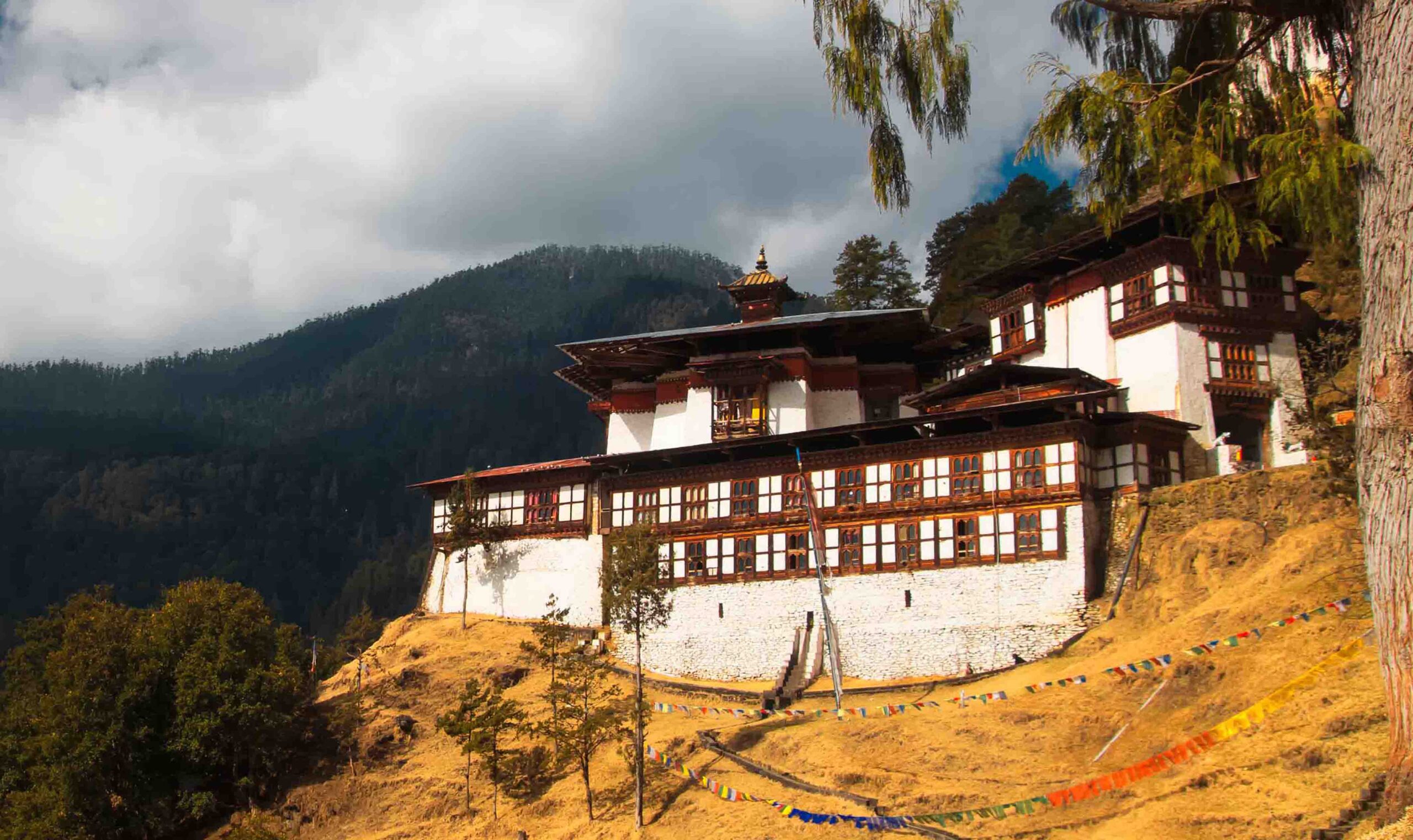
-The word Tango means Horse Head and is derived from the deity Tandin (Hayagriva) features the head of a Horse.
-In the 8th century, Guru Rinpoche recognized Tango Cheri and later Lama Phajo Drugom Zhipo as prophesied by Tshangpa Gyre visited the place.
-In 1222 AD. Lama Phajo Drugom Zhipo visited the place and while Phajo Drugom Zhipo was mediating in Dodheyna, a miracle happened. He heard the neighing of a horse coming from the direction Tango.
-He visited the place and to his surprise, he saw the cliff which was said to be the body of the deity Tandin (Horse head of Hayagriva) fully covered by roaring fire.
-The deity appeared before him in person and prophesied that Phajo Drugom Zhigpo would build a meditation centre at Tango, marry the Dakini, Khando Sonam Peldon and establish the Drukpa Kagyu School in Bhutan.
-Tango was later visited by many other notable Buddhist saints including Lama Drukpa Kuenley (“the Divine Mad Man”), lama Drukpa Kuenley’s son Lama Ngawang Tenzin who discovered many treasures and relics from the sites, Mipham Tshewang Tenzin and Zhabdrung Ngawang Namgyel.
-It was here in Tango that Zhabdrung Ngawang Namgyel meditated and also wrote down the Nga Chu Drugma ( My Sixteen Accomplishments). The corpse of his late father Tenpai Nyima was also placed inside the cave of the deity Hayagriva.
-Tango Monastery, which was originally built in 1689 by the 4th Druk Desi Tenzin Rabgye, now serves as the Institute of Advanced Vajrayana Studies.
–Gyalse Tenzin Rabye passed away in 1696 at the age of fifty nine and it is believed that the statues shed tears at the time of his passing. Still today theses tears can be traced out on the wall paintings while visiting the Dzong. There is a stupa known as Kudung chorten of Gyalse Tenzin Rabgay where his ashes are kept.
-Reconstruction of the Tango Utse started in December 2018, as the first phase of Tango Restoration Project implemented by the Department of Culture and Dzongkha Development.
Welcome to Tango Monastery.
Tango Monastery is located at about 14 kilometres north of the capital.
It geographically stands at 27 degree North, 89 degree East It is an elevation of 2900 meters approximately above the sea level.
It is roughly 45 minutes walk from parking.
1.We are lucky to take pictures from outside Monastery.
2.Please refrain from taking pictures, while we are inside the Monastery.
3.Please refrain from touching wall paintings, statues and others relics inside.
4.Please maintain low voice, when we are outside/inside.
5. Please always walk in a clockwise direction when you are visiting and touring religious places.
6. Please remove your Footwear, Hats Sunglass while we are entering inside the Statue as a sign of respect.
7.If you want to use washroom, please let me know. I will assist you.
8. Please watch your steps/ Mind your head.
9. Do remember to keep your mobile silent mode or switched off completely while entering monasteries and other religious places.
10. Do refrain from uttering any negative comments on the royal family, the country’s religion or the chief abbot.
11. Do not wear tight or revealing clothes while visiting religious areas as a sign of respect.
12. Do not throw garbage anywhere except at designated places.
13. Do not feed birds/ animals while visiting natural sites.
-The sandalwood trees found are supposed to be the walking sticks of Phajo Drugom Zhigpo.
-The Chorten, stupa found beside the Cypress is the place where Khando Sonam Peldon attained enlightenment .
-At the time of enlightenment she left behind all her belongs.
-The chorten was used to house them. Phajo Drugzom Zhigpo after his meditation also built a small temple know as Tandin Nye.
-Above the Tango Monastery, there is a retreat and meditation centre which opens only after 3 years when a batch of the meditating monks completes their retreat.
The monastery has six temples that include Trulke Temple, Longku Temple , Choeku Temple, Guru Temple, Namgsey Temple and Gonkhang (inner chapel dedication to deity).
1.TRULKU TEMPLE:
-The main statues and idols in Tulku Temple are of Buddha Shakyamuni(present Buddha), Sangay Marmey Zed,(Dipankara-the great illuminator) and Jowo Jampa (Maitreya) made out of precious metals, specifically gold and copper.
-Other statues that can be seen are eight different Buddha known as:
1.Jamyang, 2.Chador, 3. Chenrizig, 4.Namkhai Nyingpo 5.Dripa Namsel, 5. Saye Nyingpo, 6.Jampa and Jampel Zhenu Jurpa sculptured by Tulku Druk Chopel.
-Other objects of veneration in the monastery are a stone with a clear footprint of Jetsuen Tenzinma, daughter of Ngawang Tenzin and stone impression of right horses, goats and sheep.
-A golden key discovered by Ngawang Tenzin in the shape of a horse head much revered.
- LONGKU LHAKHANG
-On the second floor, there is a statue of Avaloketedhvara, Compassion Buddha made of gold and copper.
- CHOEKU LHAKHANG
-On the third floor, there are temples of Dharmakaya and a gold and copper statue of Buddha Amitayus. Buddha image is flanked by statue of Zhabdrung Ngawang Namgyel and a life size clay figure, made with medicinal metals of Gyalse Tenzin Rabgye.
- GURU LHAKHANG AND NAMSEY LHAKHANG
-Also in the second floor, there is Guru temple and the Namse palace. There is also Namsey where the statue of Namsey (vaisravana –the god wealth) is deified.
5.GOENKHANG/DEITIES SHRINE
– The Goenkhang house the statue of Pel Yeshey Gonpo,(Mahakala), the protective deity holding a skull in one hand. The skull is believed to be the skull of the famous king of Tibet, Thringsong Detsun.
-The bedroom of Gyalse Tenzin Rabgye is located to the right of the Temples.
-Central to this room is an image of Guru Rinpoche(who appeared in Tenzin Ranbgye’s vision.
-Other images are made with medicinal metals and all image here are credited by the sculptor Trulku Dzing.
– A set of paintings seen on the walls here are weeping images. The depiction of weeping is an expression of sorrow at the demise of Gyalse Tenzin Rabgye, at the age of 59 years.
-There is also a self made image Trulku Jampel Yamtsho. There is a natural fountain in the middle of the courtyard opposite to the central tower.
-There is chorten known as Jangchub Chorten or Kudung Chorten, built with the ashes of Gyalse Tenzin Rabgye.
-The most important festival held at Tango is the Yarney (summer retreat) which first started in Tango in 1967. It begins on the 15th day of the 6th month of the Bhutanese calendar and concludes on the 30th day of the 7th month of the Bhutanese Calendar.
ZERO WASTE HOUR
A Monthly initiative which is observed on every 2nd day is a decent programme that aims to inculcate habit of moral responsibility by offering just an hour picking trash and keeping our surrounding clean. The initiative, also fine-tunes our action and behaviour in being responsive towards the growing waste that the world is seeing today and how this small act can play in shaping a healthier, better and a sustainable society.
–The ZERO WASTE HOUR was launched by HER MAJESTY THE GYALTSUEN on the 2nd June 2019 coinciding with the coronation of HIS MAJESTY THE FOURTH DRUK GYALPO.